


When my youngest daughter was eight months old, I wanted to attend a Red Tent. I had read the novel by Anita Diamant and craved a supportive female space where we could talk about our experiences of family life, the menstrual cycle, pregnancy and birth. The nearest gathering was too far away so I took the plunge and started my own circle.
The first Red Tent I hosted was in my living room with a collection of curious friends and neighbours. They were invited to bring crafts along and we knitted / crocheted / sewed our way through sharing experiences of having a menstrual cycle. It became normal that we would open the circle with sharing our name and what day of the cycle we were on. (Day 1 is the first day of your period.) It became a wonderful shorthand for how people were likely to be as we understood the uniqueness of each person’s experience.
For example, while some in the pre-menstruum became sensitive to noise (me!) or smells, others would find their spatial awareness changed. Knocking glasses over or no longer being able to parallel park could be a sign that their period was due soon. What I heard again and again was that this knowledge was so precious: that understanding your own patterns of behaviour was liberating and reassuring. What I also heard was that these women wished they’d known about menstrual cycle awareness as girls, rather than discovering it in their thirties or forties.
As the talking circle grew, we moved into a yurt on the edge of some beautiful woods. All through the winter we would continue to meet, with the wood stove crackling and casting a warm glow. I remember one particular evening when there was dense fog – a real pea souper – and three new attendees were planning to join us. I wondered if they would give up, but out of the fog they appeared, looking apprehensive and relieved at the same time.
Being Vulnerable
It can take courage to attend a talking circle. People know that it’s going to involve a different way of communicating than normal and perhaps are nervous about being put on the spot or feeling too vulnerable. As a facilitator, I aim to reassure that listening is as important role in circle time as speaking. Being witnessed as your authentic and whole self, without the risk of someone jumping in to fix you, is the magic of being in circle.
Part of the reason that I wanted to attend a women’s circle was to be part of a varied community with different ages and life experiences. My heart’s desire was to have honorary aunties for my daughters to grow up around when we had no family nearby; people they could go to who would give good advice. Some of the women have been coming for 10 years and are like family. I have a feeling of belonging because of the circle that I’ve never had anywhere else.
“I believe that talking circles are like safety valves; preventing individuals from becoming isolated and communities from becoming polarised”
Choosing A Theme
Each month I choose a theme to start off the sharing. Last time, it was ‘invisibility’. Have there been times in your life when you felt invisible and it was unpleasant? Were there other times when being invisible was a positive experience? As a woman, have there been times when being visible was enjoyable or its opposite? Talking one at a time, we reflected and shared about our lives. It’s hugely validating to know that you’re not alone in an experience and enlightening to hear stories so different from your own. I believe that talking circles are like safety valves; preventing individuals from becoming isolated and communities from becoming polarised.
Over the years, being part of the circle has given people the confidence to leave jobs or ask for a promotion, to advocate for the birth that they want, to get divorced or trust that they’re worth this new wonderful relationship, or to move to another country. When there is at least one space in your life where you are listened to respectfully, where you matter, it ripples out. Being part of the circle gave me the courage to publish my first book, Ruby Luna’s Curious Journey, for younger girls to know about their bodies, including the correct words for different parts such as vagina and vulva.
Celebrating Rites Of Passage
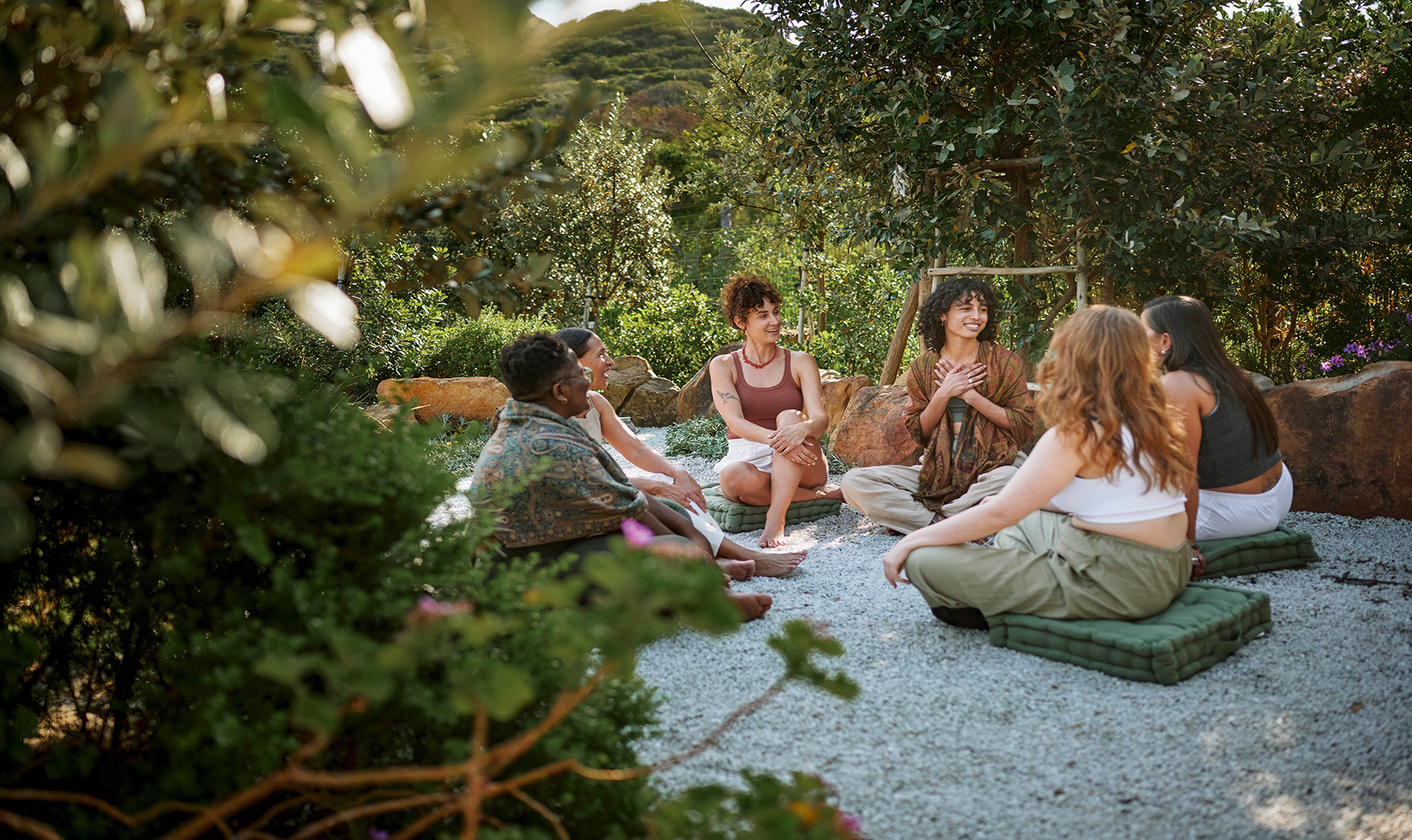
We’ve marked rites of passage together such as pregnancy, miscarriage, and the end of relationships. There have been lots of mother blessings. I remember one on a Summer evening, sat around the fire pit, singing songs and sharing stories of funny parenting mishaps, tales of strength in labour, and celebrations of the mother’s qualities. We wound a red thread around all of our wrists; the cotton bracelet only to be removed when news of the birth was received. Rather than preparing, celebrating or grieving in a small family unit, the community offers support by witnessing these life events and marking them.
Over the years, I have offered gatherings to other groups: mother and daughter circles around puberty, pregnancy and new mother talking circles, menopause circles, yoga teacher circles. Some are simply about creating a space to open up honest conversation with a cup of tea. Others include ceremony, deeper reflection, journaling, movement or mindfulness practices. All of them are connected by a clear framing of the guidelines to create a brave space for sharing: confidentiality, respect and non-judgement, talking one at a time, not fixing, and taking responsibility for yourself.
It's human nature to want to make someone feel better if they’re sad or distressed. However, in circle time, we check what the person would like in that moment. Rather than rushing in with tissues to dry up tears or with a hug to comfort, we ask, “Is there anything that you need from us right now?” Sometimes letting tears flow freely and drop off the end of your chin, or experiencing the weight of your emotions alone, is liberating and empowering.
During the pandemic, the circle went online. It was a different experience, but for most was a lifeline to feeling connected emotionally when physical connection was not possible. Sometimes, on purpose, we would not talk about the pandemic to have a break from how it was affecting our lives. Other times, we would have space to unpack how the impact was unfolding. We used breakout rooms on Zoom to talk in pairs in Listening Partnerships to create deeper connections with others and some continued this practice together between the monthly gatherings by phone.
In over a decade of experiencing and hosting circle time, I have become more comfortable with silences, a little wiser and a lot more humble. Sometimes before the evening gathering starts, I’m rushing to pick up from netball club, cook dinner and set up a welcoming space. Then I pause before the doorbell rings and take a big anticipatory breath in and out. By the end, I’m buzzing with connection and a sense of rightness in myself. The next morning, my youngest will say, “I heard your ladies cackling again!” and all is right with the world.
What is a Listening Partnership?
This concept was created by Hand-in-Hand Parenting. One person talks first, while the other listens. Eye contact, nodding, verbal acknowledgements (hmm, aha) are encouraged, but not words, even if the speaker is silent for a while. After the speaker finishes (start with 5 minutes), the listener asks clearing questions. For example, “What did you have for breakfast?”, “What colour is your top?” Questions that are easy to answer and take the speaker out of the reflective state.
Then the listener becomes the speaker. At the end of the allotted time, the new listener asks clearing questions. Rather than chatting afterwards, you could repeat the process or agree to have another listening partnership soon.
This process encourages deep listening. It can be freeing for the listener to not have to think about a response and freeing for the speaker because they know they won’t be interrupted. The topic can be “What am I feeling today?” or something that connects you such as parenting, the menstrual cycle, or perimenopause.
MORE INSPIRATION
READ Tessa is the co-author of the book Circle Holding: A Practical Guide to Facilitating Talking Circles (published by Singing Dragon).
 Follow
EXPLORE Circle facilitation trainings at tessavenutisanderson.co.uk
or follow @tessa.venuti.sanderson/
Tessa is a mum of two girls living in Berkshire. She is a yoga teacher and menstrual educator.


