


I’m not entirely sure when being healthy became so much bloody work.
There was a time when the advice seemed fairly manageable. Eat your vegetables, move your body, try not to smoke, get outside every now and then and aim for a decent night’s sleep. None of it was particularly glamorous, but at least you could remember it.
Then the podcasts arrived.
Suddenly, extremely healthy-looking men with very expensive microphones started explaining that we had apparently been waking up incorrectly our entire lives.
Simply getting out of bed was no longer enough. You needed sunlight in your eyes within a certain window. Coffee had to wait. You needed electrolytes. Your cortisol needed managing. Cold water had to appear somewhere. Breakfast became a debate and your breathing probably wasn’t optimal.
Neither was your gut, your glucose, your testosterone or your dopamine.
Somewhere between “eat your vegetables” and monitoring your glucose response to a banana, being healthy had quietly become a full-time hobby.
Then came biohacking
Biohacking went mainstream and YouTube filled up with longevity experts, optimisation gurus and people who somehow had three hours every morning to prepare for the rest of their morning.
And I watched a lot of it.
That’s the annoying part. I found it fascinating.
There was always another study, another supplement or another small adjustment that might help you sleep deeper, think more clearly, recover faster or improve your gut. Once you start looking into this world, it is incredibly easy to keep going.
Why wouldn’t you want to sleep better? Why wouldn’t you want more energy? Why wouldn’t you want to understand what is going on inside your own body?
At first, it all felt like progress. We were learning more about ourselves. Wearables suddenly allowed ordinary people to see data that would once have belonged in a laboratory or clinic. We could track our sleep, heart rate, recovery, exercise and movement.
But the more we could measure, the more things there were to improve.
Going for a walk was no longer just going for a walk. There were steps. Exercise came with zones, VO2 max and recovery scores. Sleep arrived with graphs, percentages and a number waiting for you first thing in the morning.
Suddenly, your body had KPIs.
And social media poured petrol on the whole thing.
Before you’ve even got out of bed, somebody on Instagram has already run 10k, meditated, cold-plunged, drunk something fluorescent and prepared a breakfast containing 42 grams of protein.
You haven’t even found your trousers.
The difficult part is that most of this isn’t nonsense. Exercise is good for us. Sleep matters. What we eat matters. Getting outside matters. There is genuinely useful science behind a lot of the things that came out of the biohacking movement, and plenty of it changed how I thought about my own health.
But somewhere along the way, wellness stopped simply being about feeling well.
It became something to achieve, measure and compare.
Eventually, it became another thing we could get wrong.
When your watch knows you better than you do
You wake up after what feels like a decent night’s sleep. Nothing spectacular, but you feel fine.
Then you look at your watch.
Sleep score: 62.
Apparently you had a terrible night.
Now you’re scrolling through deep sleep, REM, resting heart rate, HRV and recovery. Five minutes ago you felt rested. Now you’re wondering whether you’re actually exhausted.
Sleep clinicians have even described a version of this behaviour as orthosomnia, after seeing patients become preoccupied with achieving the right sleep data from wearable devices.[1]
I find that fascinating because it says something much bigger about optimisation.
We have access to more information about our bodies than almost any generation before us. Used properly, that can be incredibly useful. Research into self-tracking has found genuine benefits and motivations around monitoring things such as activity, exercise and sleep.[2]
But more information doesn’t always make us feel more in control.
Sometimes it does the opposite.
The question used to be, How do I feel this morning?
Increasingly, the question is, What does it say?
Social media gave wellness an audience
Comparison obviously existed before Instagram. Humans have always looked at other people and wondered whether they were doing life better.
The difference now is scale.
It used to be your neighbours, friends, people at work and perhaps one annoyingly successful cousin. Now your completely normal Tuesday morning is being compared with the most impressive forty seconds from thousands of other people’s lives.
A 2025 systematic review and meta-analysis brought together 83 studies involving more than 55,000 people. It found that greater online social comparison was associated with greater body-image concerns and eating-disorder symptoms, as well as lower positive body image.[3]
That doesn’t mean scrolling through Instagram automatically makes somebody unhappy. Association isn’t causation. But it does support something many of us probably recognise instinctively: what we repeatedly compare ourselves with can affect how we feel about ourselves.
Wellness has simply given us many more things to compare.
Our bodies, breakfasts, workouts, morning routines, sleep and even how well we relax.
We have somehow managed to make relaxing competitive.
There is also an interesting difference between being inspired by health content and actually becoming healthier because of it. In one experiment, researchers showed young women either Instagram “fitspiration” images or travel images. The women who saw the fitness content reported worse mood and greater body dissatisfaction, yet the exposure did not lead to greater exercise behaviour.[4]
That finding stuck with me.
You can consume an enormous amount of content about being healthy without doing anything particularly healthy at all.
Sometimes you simply walk away with a longer list of things you feel you should be doing.
And I think that is where wellness starts becoming work.
The awkward thing is that I work in wellness
This is where the whole subject gets slightly uncomfortable for me.
I’m not standing outside the wellness industry throwing stones at it.
I’m part of it.
I created REFIX.
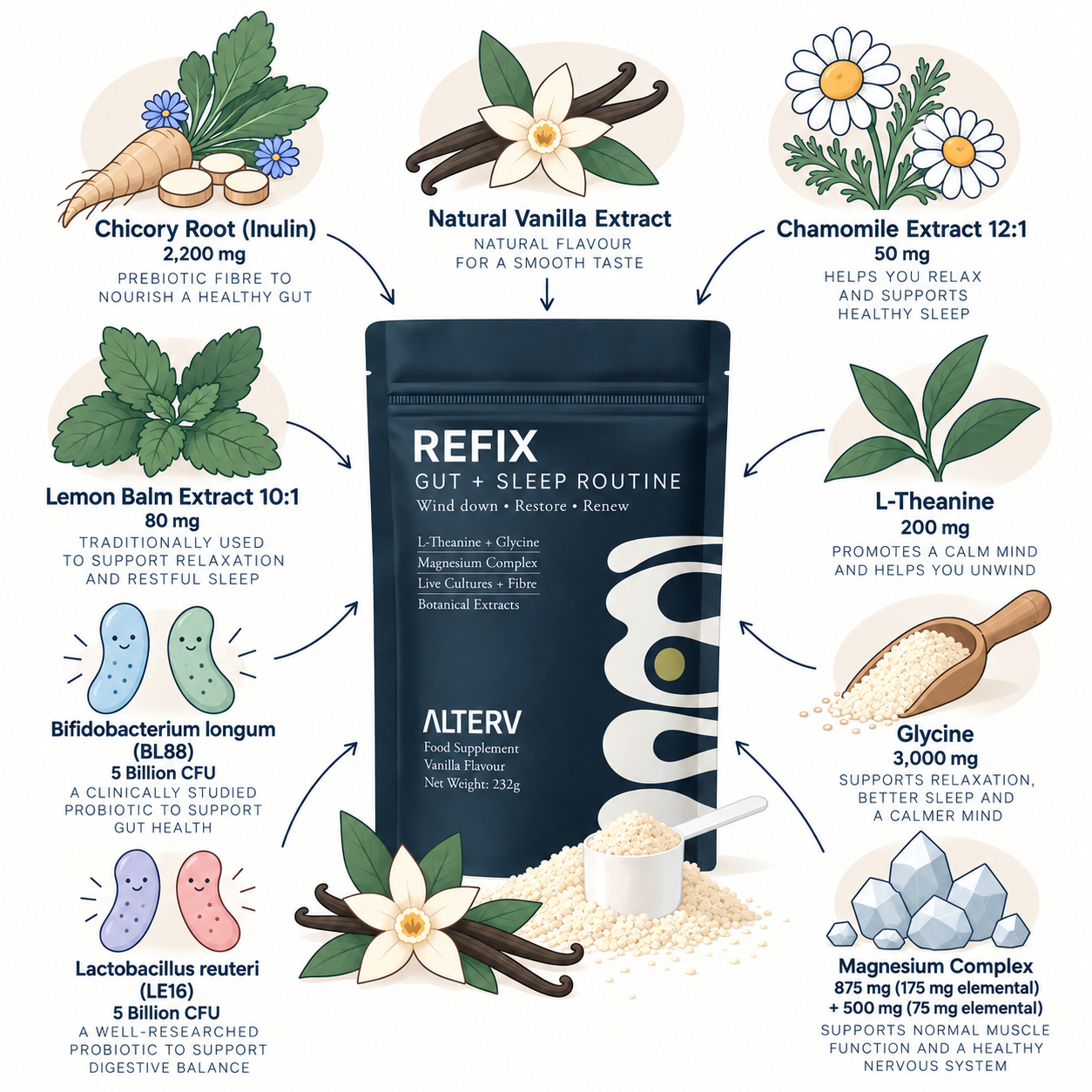
In fact, a lot of the thinking behind REFIX came from going deep into exactly this world.
I became fascinated by sleep, the gut, stress, supplements and the relationship between them. I read studies, tried products, listened to podcasts and experimented with my own routines. The deeper I went, though, the more complicated wellness seemed to become.
There was always another capsule. Another powder. Another protocol. Something to take in the morning, something else before food, something with food and something precisely forty-five minutes before going to bed.
At some point I started thinking: if a wellness routine is making you more stressed, we’ve probably misunderstood the assignment.
That became an important part of why I made REFIX.
I didn’t want to create another complicated regime. I wanted something that could fit into an ordinary evening. One product, one scoop and one small ritual before bed.
No spreadsheet required.
The longer I’ve worked on it, the more important that philosophy has become to me.
A wellness product should earn its place in your life by making something simpler. It shouldn’t need to frighten you into believing your body contains another twenty problems you hadn’t previously noticed.
And that means I have to be a little suspicious of my own industry.
Wellness exists to help people feel better, but we have also become remarkably good at finding new things for people to worry about first.
Your sleep. Your gut. Your cortisol. Your glucose. Your hormones. Your biological age. Your morning routine.
There is always another thing that could apparently be improved and, quite conveniently, often another product available to improve it.
So I’ve started coming back to a much simpler question, including when I think about REFIX:
Does this actually make life easier?
Because if something genuinely helps you, brilliant. If your watch encourages you to walk more, wear it. If running improves your mood, run. If learning about nutrition changes the way you eat for the better, keep learning.
The research on self-tracking itself is not anti-technology. There are real benefits to monitoring our behaviour.[2]
The problem begins when the tool stops working for us and we start working for the tool.
When breakfast becomes admin.
When sleep becomes a score.
When a walk doesn’t count unless the watch counted it.
When looking after ourselves begins to feel like another unpaid job.
Maybe we need to get a little worse at wellness
There are signs that this feeling is spreading.
The Global Wellness Summit identified an “over-optimization backlash” as one of its major wellness trends for 2026, describing a move away from constant measurement, performance and self-surveillance and towards a more human idea of wellbeing.[5]
I like that.
Not because I think we should throw everything away and decide health doesn’t matter.
Quite the opposite.
Maybe we just need to put all this information back in its proper place.
Your sleep score can be useful without becoming a judgement on your day. A run can improve your fitness without needing to appear on Strava. You can eat something because it tastes good without first asking what it does to your blood glucose.
And every now and then, perhaps we need an hour where absolutely nothing is being improved.
Go for a walk without recording it. Have dinner with somebody. Listen to an album without simultaneously answering emails. Sit outside. Play with your children. Waste a bit of time.
We’ve become so used to optimisation that unproductive time can start to feel like wasted time.
But think about the things that actually make a life worth having.
Friendship is inefficient. Children are spectacularly inefficient. Falling in love is inefficient. Sitting around a table talking until midnight is inefficient. Making music is inefficient. Making art is inefficient. Getting completely lost on a walk is very inefficient.
None of these things performs particularly well on a dashboard.
But they might be the whole reason we are trying to stay healthy in the first place.
Your body isn’t a spreadsheet
I don’t want to go backwards.
I like that we understand more about sleep. I like that people are talking about gut health. I like that technology can show us things about ourselves that we might otherwise miss.
I built REFIX because I believe that taking care of ourselves can make a real difference.
But I also don’t want wellness to become another version of work.
REFIX was never meant to be one more demand on somebody’s evening or another thing they have to perform correctly. The point was to bring several things I had been researching into one simple ritual, then get out of the way.
Take it. Put the phone down. Go to bed.
That, increasingly, is what I think good wellness should feel like.
Something that quietly supports the life you are already living rather than asking you to build your entire life around being healthy.
So eat well most of the time. Move your body. Get outside. Try to sleep. Look after your gut and look after your head.
Then leave some room for being human.
Stay up too late because the conversation got good. Eat the cake without checking the ingredients. Miss the workout. Lose the streak. Forget your step count. Spend an afternoon achieving absolutely nothing.
Your body isn’t a spreadsheet.
And maybe the healthiest life isn’t the one with the best numbers.
Maybe it’s the one you actually had time to enjoy.
References
- Baron KG, Abbott S, Jao N, Manalo N, Mullen R. Orthosomnia: are some patients taking the quantified self too far? J Clin Sleep Med. 2017;13(2):351-354. doi:10.5664/jcsm.6472.
- Feng S, Mäntymäki M, Dhir A, Salmela H. How self-tracking and the quantified self promote health and well-being: systematic review. J Med Internet Res. 2021;23(9):e25171. doi:10.2196/25171.
- Bonfanti RC, Melchiori F, Teti A, Albano G, Raffard S, Rodgers R, et al. The association between social comparison in social media, body image concerns and eating disorder symptoms: a systematic review and meta-analysis. Body Image. 2025;52:101841. doi:10.1016/j.bodyim.2024.101841.
- Prichard I, Kavanagh E, Mulgrew KE, Lim MSC, Tiggemann M. The effect of Instagram #fitspiration images on young women’s mood, body image, and exercise behaviour. Body Image. 2020;33:1-6. doi:10.1016/j.bodyim.2020.02.002.
- Global Wellness Summit. The Future of Wellness: 2026 Trends. Miami (FL): Global Wellness Summit; 2026.


